

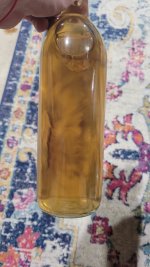
Black sediment after bottling

  • PATRONS: Did you know we've a chat function for you now? Look to the bottom of the screen, you can chat, set up rooms, talk to each other individually or in groups! Click 'Chat' at the right side of the chat window to open the chat up.
  • Love Gotmead and want to see it grow? Then consider supporting the site and becoming a Patron! If you're logged in, click on your username to the right of the menu to see how as little as $30/year can get you access to the patron areas and the patron Facebook group and to support Gotmead!
  • We now have a Patron-exclusive Facebook group! Patrons my join at The Gotmead Patron Group. You MUST answer the questions, providing your Patron membership, when you request to join so I can verify your Patron membership. If the questions aren't answered, the request will be turned down.

koniowsky717

Worker Bee
Registered Member
Nov 14, 2017
38
1
8
recently bottled a traditional mead that was crystal clear when bottled.. about a week later, it became cloudy with a strange blackish sediment. everything was sanitized prior to bottling, and even cracked one open to try and it taste fine.. just used wildflower honey, water and d47 yeast with staggered nutrient addition. attached photo -
 

Attachments

  • 20230406_142220.jpg
    20230406_142220.jpg
    323.9 KB · Views: 24
Detail for us your process to get it ready to bottle. Did you use any finning agents? Did you stabilize it with sulfites and sorbate? Filter. Did you age oak in it? Did you add anything at the end before you bottled it? Did you rack it out of a carboy/keg with some dust in the bottom?
 
Squatchy is asking the right questions (of course :ROFLMAO: ). I've seen that before in some of my aging meads, but I'm quite certain it was 'oak dust'. I also filter my meads, so I've never had that happen in a bottled mead. Without knowing more, my guess would be oak dust.
 
  • Like
Reactions: Squatchy
Since I hate bottling, my meads usually get plenty of time to settle, even after fining and racking again.

Kind of funky looking, but good to know that it could be dust from the oak. I assume this comes from just dropping in toasted oak without doing some kind of rinse in vodka or sanitizer.
 
I also hate bottling so stuff sits around in carboys for a long time before I bottle it, and sometimes I've had something sit for a year or more without dropping anything, then I bottle it and bam, next day, sediment in all the bottles, not just the ones near the bottom where I might have siphoned up some already settled sediment). From a scientific perspective, I think what happens is the agitation of bottling causes particles that'd just been hanging around in suspension to collide and stick together (which is what happens when you use a fining agent, it's called flocculation and is something I've actually studied in university and is why if you check out all the stir-plate experiments peopel were posting a decade ago, those meads drop clear very quickly) to become heavy enough to settle out. So now, if I decide it matters, I'll usually try to rack it the day before I bottle it, just in case.
 
  • Like
Reactions: MightyMosin
... sometimes I've had something sit for a year or more without dropping anything, then I bottle it and bam, next day, sediment in all the bottles, not just the ones near the bottom where I might have siphoned up some already settled sediment). From a scientific perspective, I think what happens is the agitation of bottling causes particles that'd just been hanging around in suspension to collide and stick together (which is what happens when you use a fining agent, it's called flocculation...

Hi C.G.,
It is good to see you are still meading and greeting around here. I hope you are doing well!

In addition to the agitation, I think the mild oxygen exposure/saturation that occurs during racking can also contribute to more flocculation as can temperature changes that can occur when a mead gets move from one place to another for racking.
 
  • Like
Reactions: Chevette Girl