


Some lessons learned

  • PATRONS: Did you know we've a chat function for you now? Look to the bottom of the screen, you can chat, set up rooms, talk to each other individually or in groups! Click 'Chat' at the right side of the chat window to open the chat up.
  • Love Gotmead and want to see it grow? Then consider supporting the site and becoming a Patron! If you're logged in, click on your username to the right of the menu to see how as little as $30/year can get you access to the patron areas and the patron Facebook group and to support Gotmead!
  • We now have a Patron-exclusive Facebook group! Patrons my join at The Gotmead Patron Group. You MUST answer the questions, providing your Patron membership, when you request to join so I can verify your Patron membership. If the questions aren't answered, the request will be turned down.
Thanks for all of the help Wayne. Greatly appreciated. The mead is progressing very well. There is certainly still enough active yeast, as it is now bubbling like crazy with all the new sugar in the form of the mango juice and prickly pear pulp. As mentioned, it has stratified into three distinct layers.

The slurry appears to be at the bottom. Then there is a lighter layer where I think the yeast is at work and then above it (say 80% of the carboy) a beautiful mead.

I will leave it alone for a while and then take a weekly SG reading.

Any comments on the impulse addition of the vodka-soaked mint leaves?
 
Here's a silly question, "how would I measure the SG of this batch, when the mead has quite distinctly stratified into a very clear (beautifully colored) upper (say 80%) and a very thick syrupy lower section?"

I decided to give it a careful shake up, without causing any splashing. Just a gentle mixing up of everything. Was this a good idea? I just couldn't see the yeast getting to this very thick lower section, although the very top bit of this slurry was a lighter color.

After replacing the lock, it continued it's regular bubbling after a minute or two.

Comments?
 
I gave the mead two more gentle shakes over a week and the sediment is suspended for a while but after a few hours has stratified back into it's two layers. We had slightly lower temperatures (16 deg c 60 deg F) and this morning the top portion has cleared beutifully, to the extent that I can almost see through it.

I am uncomfortable with the sediment layer at the bottom because it obviously contains the lees and un-dissolved fruit slurry. My gut feel is to rack off this amazing looking mead at the top but my problem is that once again I don't have a small enough carboy to fill it to the top. Fermentation has slowed considerably (may be just the cooler night temperature) with 1-2 bubbles through the fermenantion lock.

Should I check the SG of this top layer and then make a decision?

When do I bottle?

Any advise would be appreciated.
 
Measured the SG at 1.021 ABV% should thus be 12.58% (from 1.116)

It is a beautiful clear amber color and very tasty (after chilling). Much smoother than earlier tastings. Disappointingly, no hint of the mint, mango or prickly pear.

The question remains, should I rack it off the stubborn sediment?
 
If you check the SG again after 3 days or so and it has remained constant, then yes it is time to rack to an aging vessel. Fermentation is likely done then. However, make sure that you airlock it -- yeast have at times "reawakened" after a racking, even if the liquid is mostly clear, to start up fermenting all over again.

You will need to try to do something to fill that extra headspace if you can't find a small enough carboy. You are now at the point where introduction of oxygen is not a good thing.
 
Synaptoman,

You were asking if anyone thinks you can learn from your mistakes on this batch.

As far as I can tell, though, you haven't make any mistakes yet; not in methods anyway. All that stuff you were worried about was trivial, up until the part about the carboy with too small of a neck and too much headspace.

The only mistake might be, that you started out with such a fantastic rare ingredient (fynbos honey), and a compatible yeast, and now instead of climbing up your learning curve on this honey's potential, you are quickly flattening it down by mixing it up with small quantities of mango, prickly pear, and mint.

Good luck, though. Give it another year and bottle it, -- sounds like you will have a wonderful product.

Keep posting! BTW, it isn't quite true that people learn from their mistakes. What people learn from, is correcting their mistakes.
 
The only mistake might be, that you started out with such a fantastic rare ingredient (fynbos honey), and a compatible yeast, and now instead of climbing up your learning curve on this honey's potential, you are quickly flattening it down by mixing it up with small quantities of mango, prickly pear, and mint.

My feelings exactly and that is why I cheated somewhat ;D by starting an identical batch two weeks later (but with D47) but this time making none of my little mistakes (or the big one) and not messing around with the fruit.

The first batch (with the massive blob of sediment at the bottom) is really proving to be interesting. I have so far resisted the temptation of racking it off of this sediment and I think that my patience has paid off. It has cleared beautifully and I can now see thousands of tiny bubbles floating up from the fruit sediment. It also seems to be getting smaller !! Constant blurps from the fermentation lock, so it seems that the yeast is still hard at work on the fruit. Quite intriguing. SG (of the clear mead at least) is dropping nicely and it tastes great. So I am just going to be patient.
 
After a week or more of no airlock activity, I racked off of the lees and fruit sediment. Filled right up the neck of the carboy with 5L of white grape juice. Tasted and tested SG (before adding grape juice). SG = 1013.

Mead tasted FANTASTIC !!

I'm wondering if the SG is going to continue to drop or if it will just age at this SG. I still have an airlock on for safety sake.
 
Sample and measure the SG over the course of the next several weeks. It may pick back up again, or not, depending on the state of your yeast (simply dormant, or in fact deceased). It is good to keep it protected under an airlock for the next couple of months, at least.
 
Bottled !!

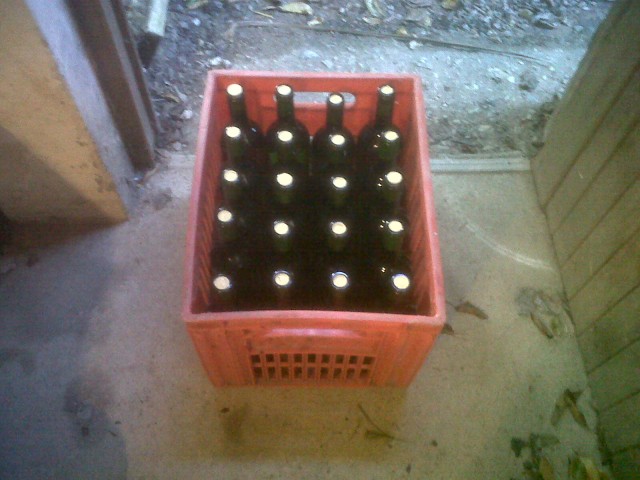
After a year maturing in the carboy with an airlock in place just in case, we decided to bottle this mead, named Blombos 2010, two weeks ago. It finished of at 13.54%. It's delicious and I assume it will get even better after a year or two in bottles. Here is a case of the final product and an image of the mead in the glass for your interest.

img-20110430-00111-e1305716196894.jpg


img-20110430-00113-e1305715056552.jpg


Cheers and thank you to everyone at Gotmead for the help.