

Headspace

  • PATRONS: Did you know we've a chat function for you now? Look to the bottom of the screen, you can chat, set up rooms, talk to each other individually or in groups! Click 'Chat' at the right side of the chat window to open the chat up.
  • Love Gotmead and want to see it grow? Then consider supporting the site and becoming a Patron! If you're logged in, click on your username to the right of the menu to see how as little as $30/year can get you access to the patron areas and the patron Facebook group and to support Gotmead!
  • We now have a Patron-exclusive Facebook group! Patrons my join at The Gotmead Patron Group. You MUST answer the questions, providing your Patron membership, when you request to join so I can verify your Patron membership. If the questions aren't answered, the request will be turned down.

NectarOfTheGoddess

NewBee
Registered Member
First off, resolution #1 done even before the new year: Register at GotMead. Yay and hi!

So my question is re: headspace. I started making mead this past spring and the vast majority have been melomels. I mostly stick with one gallon batches, but each time I rack them, they decrease in volume (of course). So I am always left with more and more headspace in the carboy. I've heard both sides: that headspace is something to be avoided and also headspace isn't much of a concern with melomels. Which one is true? And if headspace should be avoided, how exactly does one do that? All I can think of is getting smaller glass jugs to rack the mead in to.

Thanks for any info.
 
Hi and welcome... Others may have alternative ideas from adding sanitized lead free glass marbles to adding a noble gas (like argon ) but my trick is simpler - I make more than a gallon (my primary is a bucket) and I store the excess in an airlocked bottle (could be 750 CC or 1.5 L) and then use that to top up the target carboy.
 
Couple of other tricks. You can purchase compressed CO2 which you can then use to fill any head space and drive out oxygen. CO2 is heavier so if handled softly it'll just lift the oxygen out.

The other idea comes from the wild lab chemist in me. Wait to rack until you have another batch in active primary ferment. Then run a blowoff tube from the above ferment into the top of the secondary carboy you want to drive the oxygen out of! 😎

I typically ferment in 5 gallon batches (go big or go home, my motto) and have had no issues with oxidizing any meads, even those I've racked four or five times.
 
Head space really only becomes an issue after your batch hits the 1.030 SG. If it contains fruit the sensitivity to oxidation becomes higher and head space must be more carefully managed.

I've ended up making some 1 gallon BOMM batches that I use to top off fermenting carboys. Have also used a mead that I wasn't crazy about because it was too sweet or not sweet enough, but already bottled, to top off. Have also topped off melomels with some home made muscadine wine.
 
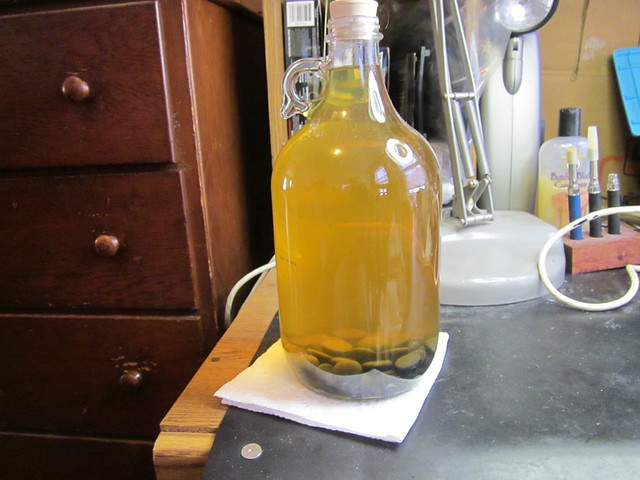
I have a collection of glass jugs in all different sizes. The 1 gallon and 1/2 gallon sizes get used the most. Over time if you use the same recipe often enough you'll have small quantities that lend themselves to being top off. In a pinch I'll use some sanitized glass marbles - I get them from crafts stores in the floral craft section:

22645252139_dd1d5072e0_z.jpg


This 1/2 gal will be used to topoff a cyser that's currently in primary.
 
Nearing the end of my 3rd batch of JAOM. Day 84 comes around and only then do I realize, I didn't top up the headspace. It is 3 7/8 in. from bottom of airlock. It's almost cleared and ready. Not much I can do now, is there? First time I forgot a recipe step. I predict it will still be drinkable.
 
I'm still a newbie myself, but if it's under airlock and produces some CO2 still (even if it's just a bubble a day), from what I understand it should be fine. It's not ideal, but it should be fine since the CO2 blankets out the oxygen, which is what you want to avoid. I'll wait for more senior/experienced members to comment on this though if I were you.
 
The myth.

The CO2 “blanket” is a myth. It happens only if the velocity of the CO2 is almost zero and occurs deep enough that the normal air current cannot reach it. That is why CO2 stratifies in trenches and mines. Bubbles rising from the mead or compressed CO2 (velocity too high) will not form a blanket in something as shallow as a carboy headspace. However, both will sufficiently dilute air in the headspace given enough CO2.

The best solutions, several of which have already been stated, (in no particular order of preference) are: 1) to make larger batches to compensate for racking losses (requiring several different sized carboys to hold the extra mead); 2) have a number of progressively smaller carboys available to minimize headspace when racking; 3) use lead-free marbles to reduce headspace; and 4) top-off with a similar mead.

Mead is resistant to oxidation and a small amount of headspace will not affect the quality significantly.
 
Sounds like it should be alright, then. Not necessary to top up with similar mead now? Almost ready to bottle. I'll post findings after bottling. Thanks for the information/knowledge base!

:cheers:
 
So, the JAOM turned out simply delicious. Other than more headspace, the only thing changed was honey. This mead is truly foolproof! For this fool anyway! So delicious, I'm making two more batches! I'm drinking more than I figured. They average 96 days before drinkability.
I gifted a few bottles to friends, who haven't experienced mead, and one liked it so much, one of the two batches is for him! :occasion14:
Stepping out to make a more involved mead, probably melomel. Maybe just a show mead.
I greatly appreciate all the beekeepers! Thank You for what you do!
I have a greater understanding of pesticides and other poisons that kill bees/colonies. Mead has changed the way I live, and also helped take the edge off minor back pain! Collateral Victory!!
:cheers:
thebeesmead