




Here's the recipe GF and I followed:
12 lbs. Meadowfoam honey
4 gallons of treetop brand apple juice (Preservative free is important if treetop is unavailable)
DAP (Diammonium phosphate)
Fermaid k (or other yeast energizer, avoid ones containing urea)
lalvin ec-1118 yeast
pour half of one bottle into the fermenter, add 1/4 of the honey, shake like hell. (this not only dissolves the honey but aerates to allow for healthy yeasties)
Repeat until all honey is dissolved and in the bucket. Toss in the cinnamon.
Add 1 tsp of DAP and 1/2 Tsp of Fermaid k to the must (The stuff in the bucket is your must) then at 24 hrs add 1/2 tsp Dap and 1/4 tsp fermaid k, then at 72 hrs add 1/2 tsp Dap and 1/4 tsp fermaid k.
rehydrate yeast according to directions on package
always remember sanitation is key. make sure your yeasties and your must (the mead you are making is called must at this point. It's a
wine making term) are at the same temerature when pitching so you don't shock them.
the airlock should start bubbling like crazy within the first 24 hours. it is ready to drink when you can read a newspaper headline through it.
Had some trouble initially with the SNA but things went fine from there, the original poster of the recipe said to use degas and use gelatin to fine it. She tried it with no real clearing effect so recommended using Sparkalloid. 9 days later she ask me to check on something. It very possibly could be a mold spore but I don't know. She didn't stabilize the mead once it finished before clearing.
There's no "tail" from what I can see but here's the best I could do for pictures.
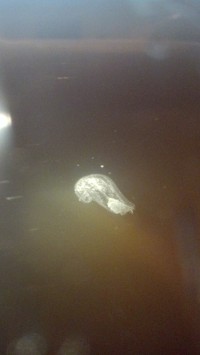
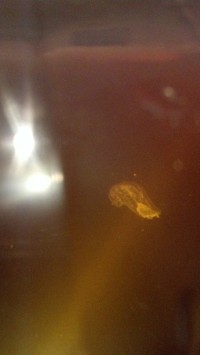
For degassing she used a vacu-vin wine saver.
Which leads me to my only lead to an "if this is mold I have a good idea where it came from" thought. She attached a sterilized airlock and rubber stopper to the 5gal carboy, placed the vacu seal part against the airlock and began pumping. She over did the pumping from what she told me as the cork got sucked right into the carboy. I told her it shouldn't be too big a panic as I've done the same with synthetic stoppers and had no ill effect, however it being a rubber stopper we should quickly transfer to a new carboy just to be safe. This was all done during the first week she used the gel. Things seemed fine no mold or anything questionable so a week later we siphoned into a new carboy and added the spark.
Like I said I don't really know if this is mold or not. If it is? Could've happened with the stopper incident. Or could have begun after the spark was added. Looking over the top of the mead in the carboy theres a slight white blanket, barely noticeable but something I normally see on other meads before they clear. around the rim of the carboy are what look like white sand grains which I thought were from the spark addition which has created a pretty thick bed at the bottom of the carboy.
Any and all help is appreciated. I'd like to assume all is well, but if someone did pull a black briar on this then....I do believe I'll open a bottle of cinnful cyser.
12 lbs. Meadowfoam honey
4 gallons of treetop brand apple juice (Preservative free is important if treetop is unavailable)
DAP (Diammonium phosphate)
Fermaid k (or other yeast energizer, avoid ones containing urea)
lalvin ec-1118 yeast
pour half of one bottle into the fermenter, add 1/4 of the honey, shake like hell. (this not only dissolves the honey but aerates to allow for healthy yeasties)
Repeat until all honey is dissolved and in the bucket. Toss in the cinnamon.
Add 1 tsp of DAP and 1/2 Tsp of Fermaid k to the must (The stuff in the bucket is your must) then at 24 hrs add 1/2 tsp Dap and 1/4 tsp fermaid k, then at 72 hrs add 1/2 tsp Dap and 1/4 tsp fermaid k.
rehydrate yeast according to directions on package
always remember sanitation is key. make sure your yeasties and your must (the mead you are making is called must at this point. It's a
wine making term) are at the same temerature when pitching so you don't shock them.
the airlock should start bubbling like crazy within the first 24 hours. it is ready to drink when you can read a newspaper headline through it.
Had some trouble initially with the SNA but things went fine from there, the original poster of the recipe said to use degas and use gelatin to fine it. She tried it with no real clearing effect so recommended using Sparkalloid. 9 days later she ask me to check on something. It very possibly could be a mold spore but I don't know. She didn't stabilize the mead once it finished before clearing.
There's no "tail" from what I can see but here's the best I could do for pictures.


For degassing she used a vacu-vin wine saver.
Which leads me to my only lead to an "if this is mold I have a good idea where it came from" thought. She attached a sterilized airlock and rubber stopper to the 5gal carboy, placed the vacu seal part against the airlock and began pumping. She over did the pumping from what she told me as the cork got sucked right into the carboy. I told her it shouldn't be too big a panic as I've done the same with synthetic stoppers and had no ill effect, however it being a rubber stopper we should quickly transfer to a new carboy just to be safe. This was all done during the first week she used the gel. Things seemed fine no mold or anything questionable so a week later we siphoned into a new carboy and added the spark.
Like I said I don't really know if this is mold or not. If it is? Could've happened with the stopper incident. Or could have begun after the spark was added. Looking over the top of the mead in the carboy theres a slight white blanket, barely noticeable but something I normally see on other meads before they clear. around the rim of the carboy are what look like white sand grains which I thought were from the spark addition which has created a pretty thick bed at the bottom of the carboy.
Any and all help is appreciated. I'd like to assume all is well, but if someone did pull a black briar on this then....I do believe I'll open a bottle of cinnful cyser.


